Virtue Theory
Virtue theory is an agent-centred normative ethical system that defines the personal qualities that make a person moral, focussing on a person's character rather than specific actions. It argues that to be good is to act as a virtuous person would in a given situation.
Aristotle - an Ancient Greek philosopher - argued that a virtuous person is someone who has ideal character ("ethos"). It derived from natural human traits, but needs to be nurtured in order to become stable.
A virtuous person is someone who's manner of behaviour ("hexis") is kind, courageous, or generous over their lifetime because it is their character, not because it is beneficial to them, utilitarian, or their duty.
Eudaimonia
Aristotle called the final purpose for adult humans as Eudaimonia. He defined it as the greatest good for a human being, often translated as "happiness" or "human flourishing". It is the most fulfilling position a human can be in and should be the final goal of all action. A person who has achieved Eudaimonia will be fully content in their life, act completely morally, but also desire to do so. It cannot be achieved passively; you must work hard to achieve it.
Eudaimonia also involves reason; animals and children cannot achieve eudaimonia. Reason is unique to humankind and eudaimonia is the greatest human achievement. Phronesis is an intellectual virtue only available to adults, meaning while a child may grow up to be a virtuous person, they themselves cannot yet be virtuous.
However, Eudaimonia cannot be an individual pursuit. Famously, Aristotle wrote in Nicomachean Ethics, "Man is a political and social animal." Social and political activity is integral to virtuousness. Eudaimonia lies in interactions you have with others.
We achieve Eudaimonia through practice and education. Aristotle uses the analogy of an Archer aiming for a target of goodness. You need instruction, and then practice. Instruction comes from our education, upbringing, and parents. Aristotle argued that by practicing virtuous traits, we eventually become lke those traits.
Eudaimonia is pursued for its own merits, rather than a means to an end. "Eudaimonia is an end in itself."
The Nature of Virtue
Virtues ("arete") are moral excellences - any trait or quality valued as being good. They promote individual and collective wellbeing, getting us closer to Eudaimonia. The opposites are vices, which should be rid from your life to leave space for virtuous actions.
Aristotle believed that there were four groups of people in society.
1. Virtuous People (Sophron - enjoy doing good, face no moral dilemma
2. Continent People (Enkrates) - do virtuous things mostly, but have to overcome dilemma
3. Incontinent People (akrates) - face moral conflict and usually choose a vice
4. Vicious People - make no attempt to be virtuous
He also believed that virtues could be separated into two kinds: moral and intellectual virtues.
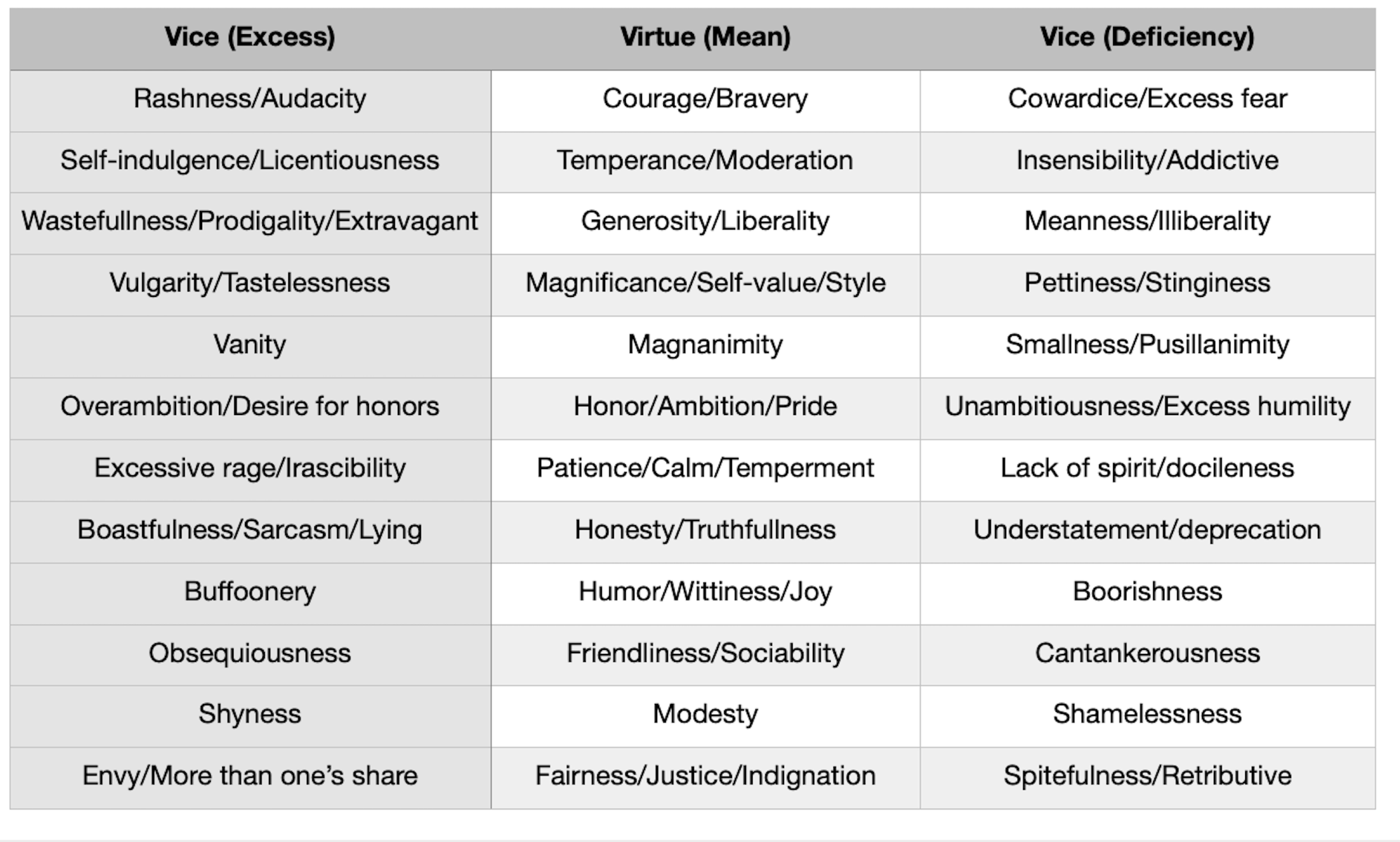
Moral Virtues include courage, temperance, modesty, patience, and honesty. They are qualities of character attained by habit and cultivation. There are 12 moral values outlined in Aristotle's doctrine of the mean.
Intellectual Virtues include science (epistime), art (techne) prudence (phronesis), intuition (nous), and wisdom (sophia). They are developed through instruction. There are 5 intellectual values.
There are 2 of each kind that are considered cardinal values (coming from the word for 'hinge') which are thought to be the most important of the 17 virtues. They were outlined by Aquinas in his Natural Law.
The Doctrine of the Mean
The 12 moral virtues are thought of as the midpoint (or golden mean) between a vice of deficiency and a vice of excess.
Virtue Ethics and Jesus' Teachings
Jesus seems to show concern for virtue in various letters of Paul (Galatians), as well as Matthew's gospel, but nothing is mentioned explicitly or systematically of virtue theory.
In 1 Corinthians, Paul lists faith, hope, and love as the most important personal qualities, given to us by G-d, as agreed by Aquinas. Elsewhere, Paul other virtues or "fruits" that Christians should demonstrate as a result of their relationship with G-d.
Jesus' Beatitudes from the Sermon on the Mount in the book of Matthew (5:3-11) are often used as evidence for compatibility of virtue ethics with Christianity.
Matthew 5:3-11:
3 “Blessed are the poor in spirit,
for theirs is the kingdom of 'heaven.
4 Blessed are those who mourn,
for they will be comforted.
5 Blessed are the meek,
for they will inherit the earth.
6 Blessed are those who hunger and thirst for righteousness,
for they will be filled.
7 Blessed are the merciful,
for they will be shown mercy.
8 Blessed are the pure in heart,
for they will see God.
9 Blessed are the peacemakers,
for they will be called children of God.
10 Blessed are those who are persecuted because of righteousness,
for theirs is the kingdom of heaven.
11 “Blessed are you when people insult you, persecute you and falsely say all kinds of evil against you because of me.
Jesus was concerned with the virtue of love in addition to law, but places less emphasis on the latter. He warns against anger and lust, rather than focussing on prohibitions on murder and adultery. He moves away from the law-centred ethics of the Pharisees, who had become selfish and at odds with each other because of them.
Matthew 5:48: "Be perfect, therefore, as your heavenly Father is perfect."
He was also concerned with social and political virtues and welfare and fought to make his society a better place. This is compatible with Aristotle's thinking.
Weaknesses of Virtue Ethics
Non-Normativity
Virtue theory does not have a clear list of prohibitions, nor does it give you means to formulate one. Therefore, how do you punish people who act immorally? How do you develop a society without rules? How do you advise people to become more moral when there is no definitive direction or advice? The lost remain lost and without eudaimonia. HOWEVER, it can be argued that if there were rules, those that could not function in virtue theory would not be able to follow rules properly. You cannot achieve Eudaimonia just by mindless obedience.
Practicality
Virtue theory is difficult to follow, especially in dilemma, because of the lack of clear rules. How would we apply it to modern issues like stem cell research or abortion? There are no concrete answers.
Non-Universality and Cultural Relativism
The nature of virtues is different for different people, cultures, and societies at different times, making it difficult to establish. HOWEVER, some argue that a virtue must be a universal virtue for all people at all times to be defined as such, making it irrelevant. Others argue that virtues must be relative and grounded in a given culture.
Immoral Acts
Virtue theory can be used to justify immoral acts in its subjective nature. A virtue theorist may argue someone who commits a murder lacking in several virtues (compassion, fairness, etc_ but there are no rules to suggest that the murder itself is wrong. If anything, they are likely portraying virtues like braveness or ambition. Virtue theory leaves legislation in a difficult position.
Ancient Values
Ancient society was very different to our own and so thinkers like Aristotle and Aquinas were perhaps not equipt to comment on modern life and ethical dilemmas. For example, different vices and virtues may be more relevant today. Aristotle argued that, "all paid jobs absorb and degrade the mind." If we are all required to work in a modern capitalist world, how can we be expected to reach Eudaimonia?
Judgement
If there are four types of people, why is the person who acts immoral on accident while trying to be virtuous worse than the individuals who do not have to try at all? Should there not be credit for intention? Similarly, there may be actions that appear virtuous that have immoral motives that cannot be perceived, making judgement in law impossible. This is similar to the complaint of non-normativity. How do you create a society where there are no rules?
Elitism
Aristotle claims that only individuals with a formal education can reach eudaimonia, because otherwise they have not been educated on the virtues and also have not experienced the necessary character building. This puts a correlation between morality and wealth (especially in the ancient world). Additionally, shouldn't the attempt to overcome the obstacle of lacking education be credited?
QUOTE BANK!!!!
Aristotle: "All men by desire knowledge."
Aristotle: "At his best, man is the noblest of all animals; separated from law and justice he is the worst."
Aristotle: "Education is the best provision for old age."
Aristotle: "We are what we repeatedly do. Excellence, then, is not an act but a habit."
Aristotle: "Good habits formed at youth make all the difference."
Aristotle: "Happiness depends upon ourselves."
Aristotle: "Man is a political and social animal."
Aristotle: "Eudaimonia is something final and self-sufficient, and is an end in itself."
Aristotle: "Eudaimonia depends on ourselves."
Aristotle: "It is easy to miss the target and difficult to hit it.
Matthew 5:3-11: "Blessed are those who hunger and thirst for righteousness,"
Galatians 5:22-23: "But the fruit of the spirit is love, joy, peace, patience, kindness, generosity, faithfulness, gentleness, and self-control. Against such thing there is no law."
Aristotle: "All paid jobs absorb and degrade the mind."
Cave: "People have recognisable reasons for doing what is right because doing what is right, it is argued, is likely to lead to their happiness. Morality and personal happiness are entwined."
Mackie: "what constitutes the right amount, the virtuous choice, is determined as the man of practical wisdom would determine it; ad he is the man who is good at choosing the means to the end of eudaimonia."
Scruton: "happiness is an activity of the soul in accordance with virtue"
Scruton: "It is absurd to ask why we should pursue it, since success or fulfilment is what every activity intends."
Aristotle: "But we must add, 'in a complete life'. For one swallow does not make a summer, nor does one day; and so too one day, or a short time, does not make a man blessed and happy."
Aristotle: "philosophic wisdom and understanding and practical wisdom being intellectual, liberality and temperance moral."
Aristotle: "moral virtue comes about as a result of habit, whence also its name (ethike) is one that is formed by a slight variation from the word ethos (habit)."
Pythagoras: "Wisdom, thoroughly learned, will never be forgotten."
Norman: "[Virtue] is a central theme of Jesus' Sermon on the Mount, which begins with the Beatitudes."
Proverbs: "There are six things the L-rd hates, seven that are detestable to him."
Churchill: "He has all the virtues I dislike and none of the vices I admire."
Steinbeck: "We value virtue but do not discuss it. The honest bookkeeper, the faithful wife, the earnest scholar get little of our attention compared to the embezzler, the tramp, the cheat."
Aristotle: "It is no easy task to find the middle...wherefore goodness is both rare and laudable and noble."
Aristotle: "Virtue, then, is a state of character concerned with choice, lying in a mean..."
Vardy: "However, let us suppose that the vegetative part of me needs sustenance or nutrition and growth. Now, the desiderative part of me desires cake rather than fruit. However, the scientific part of me knows the fact that, given my current waist size, fruit will do me more good than cake will. So, finally, the calculative part of mind thinks about the advisability of cake over fruit or vice versa, and comes to a decision: How about 'fruit cake'? The scientific part of my mind will then be able to follow the precise instructions on how to make a reasonably respectable fruit cake of the health-food variety. Thus the vegetative, desiderative, calculative and scientific parts of my 'soul' have all come into play. "
Aristotle: "Nobody would choose to live without friends even if he had all the other things."
Aristotle: "friendliness is considered to be justice in the fullest sense."
Comments
Post a Comment